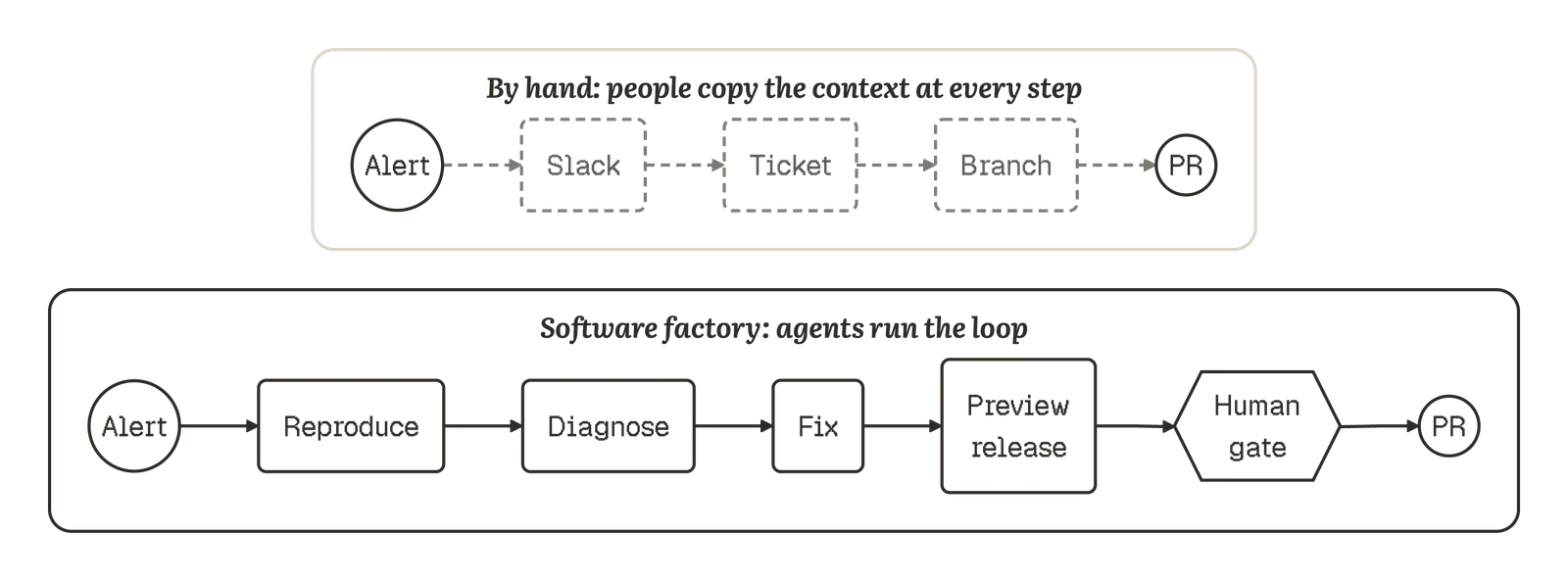
The Astro team reported in a blog post that a pipeline of AI agents had cut the repo’s open GitHub issues from more than 200 to about 30. For each bug, the pipeline reproduces it in a sandbox, diagnoses the root cause, and ships a preview release that the original reporter can verify. Astro calls this pipeline a software factory, a concept that many software companies are now trying to build, and has open-sourced the pipeline.
The idea is that a production bug already moves through a loop with clear inputs and outputs. People copy context from alert to Slack to ticket to branch to PR. A software factory for bug fixes runs that loop as a system of agents.
This innovation matters most for consulting firms whose offering rests largely on their clients’ legacy systems. These firms do the complex work of reading and maintaining that code, triaging issues to separate bugs from features, and modernizing the systems without breaking anything.
But what happens when clients can do this work in-house, more easily and cheaply, without hiring expensive transcultural contractors? I expect most clients to bring the work in-house, and these firms to lose more clients every year as those clients learn to leverage AI.
These firms can shift their offering from “we have many cheap engineers who can read your legacy code and grind through tickets” to designing and setting up software factories. Each software factory fits a client’s own budget, criticality, and compliance constraints.
You may ask why clients would not build software factories in-house too. I believe these firms really sell two things. The first is experience: they have maintained legacy systems for many clients, so they know where a factory is likely to break on a legacy codebase. The second is confidence that the software factories work as intended, that the right human verification gates are in place, and that nothing triggers a regulatory issue. Because LLMs are non-deterministic, that confidence matters even more. After all, consulting firms have long sold expertise and risk transfer as well as hours.
Firms that bill hours for ticket triage, or whose edge is labor-cost arbitrage, are the most exposed. Firms that productize a factory, price it on outcomes and put their name behind it are the best placed. This holds most in regulated industries, where a client’s own compliance team will likely want an outside party to share the risk.
Astro is close to a best case, with strong tests, reporters who send reproductions and maintainers who know the code. Its team says that when the pipeline fails, the cause is usually opaque abstractions, missing comments or thin test coverage. This is one open-source project reporting its own results, so whether the approach works for a regulated bank is still unproven.
Clients that build their own factories will still face one question when something goes wrong: who vouches for this? Consulting firms that can answer it, with experience, gates, audit trails and a contract behind them, will have a business. Those that cannot will be competing with a free GitHub Action.